









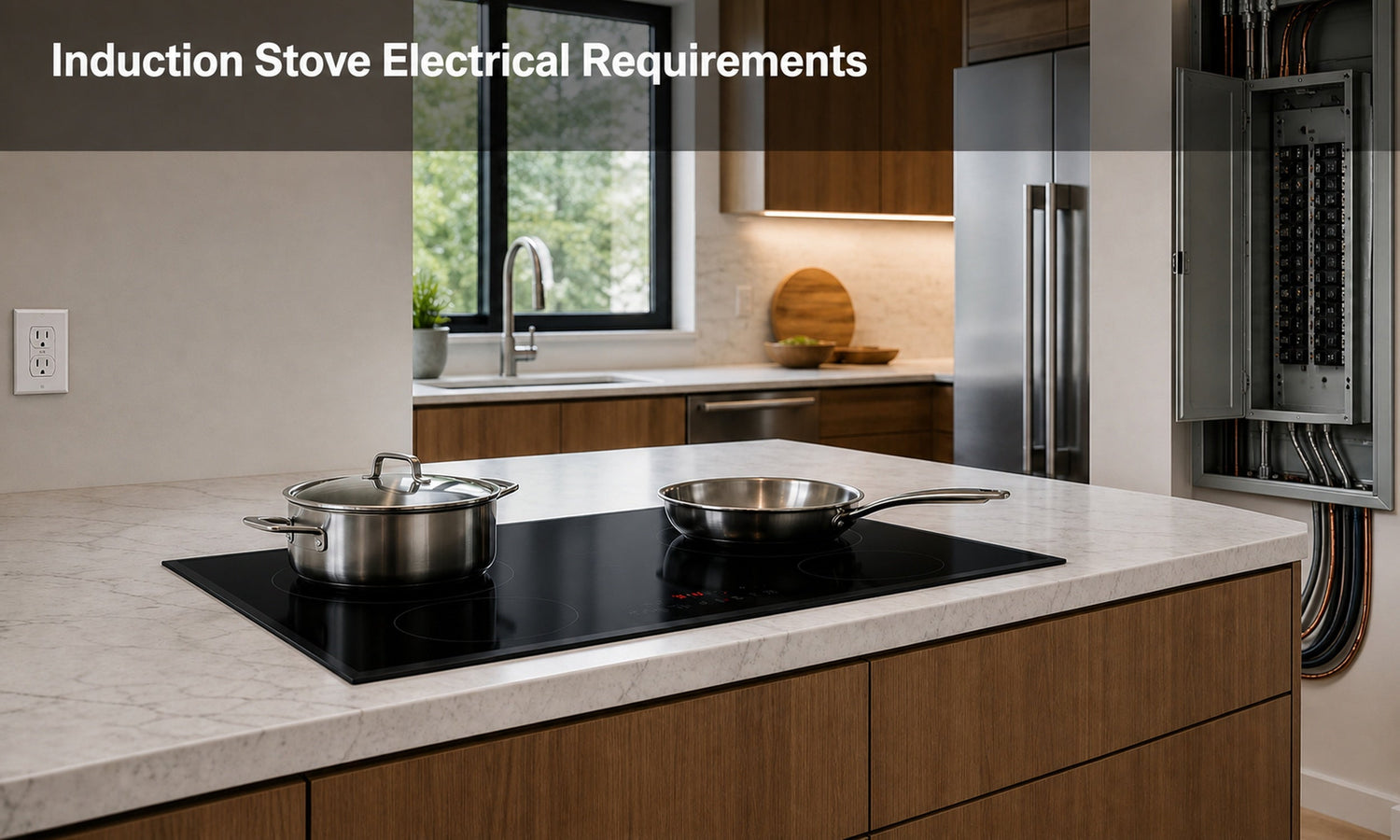
If you're thinking about switching to an induction stove, one of the first questions you may have is: Do I need special electrical wiring for an induction stove?
The answer depends on the type of induction appliance you choose.
Full-size induction ranges and built-in induction cooktops or electric ceramic cooktops usually require a dedicated 240-volt circuit, while portable induction cooktops typically plug directly into a standard 120-volt outlet and do not require rewiring.
Understanding the difference before you buy can help you avoid unexpected electrical work and installation costs.
Do Induction Stoves Need Special Wiring?
Most full-size induction stoves and built-in cooktops require more electrical power than standard kitchen appliances. Instead of plugging into a typical 120V household outlet, they generally require a dedicated 240V circuit connected to the home's electrical panel.
The reason comes down to how much power an induction cooktop can use. For example, consider a 3-burner induction cooktop where each cooking zone can draw up to 1,800 watts. If all three burners operate at full power simultaneously, the total power demand could reach:
1,800W × 3 = 5,400W
At 120V, supplying 5,400 watts would require approximately 45 amps:
5,400W ÷ 120V = 45A
That is far beyond the capacity of a typical 15A or 20A household circuit.
At 240V, however, the same 5,400W load requires approximately 22.5 amps:
5,400W ÷ 240V = 22.5A
This is why high-power, full-size induction cooktops and ranges commonly use 240V dedicated circuits. The higher voltage does not mean that the three burners add up to 240V. Instead, 240V allows the appliance to deliver high power while drawing less current from the circuit.
Keep in mind that induction cooktops may regulate or limit the power shared between cooking zones, so the maximum wattage of every burner may not always be available simultaneously. Always check the manufacturer's specifications for the appliance's required voltage, amperage, and circuit size.
What About Portable Induction Cooktops?
Not every induction cooktop requires special wiring. Portable induction cooktops are designed to operate from standard 120V household outlets.
For example, a portable induction burner rated at 1,800W would draw approximately:
1,800W ÷ 120V = 15A
This is why many portable induction cooktops can be used with an existing, properly rated household circuit without installing a new 240V circuit.
So, if you want induction cooking without rewiring your kitchen, a portable 120V induction cooktop can be a much simpler option. For a full-size induction range or built-in cooktop, however, you should check whether your kitchen already has a suitable 240V circuit before purchasing.
Amperage and Wiring Specifications Overview
Full-sized induction units require dedicated heavy-gauge copper wiring connected to a dedicated double-pole circuit breaker in your electrical panel:
| Appliance Type | Rewiring Required? | Voltage | Circuit Amperage | Wire Gauge (Copper) | Outlet / Connection Type |
| Portable Induction Burner | No | 120V | 15A – 20A (Shared/Existing) | 14 AWG / 12 AWG | Standard NEMA 5-15 / 5-20 |
| 30" or 36" Built-in Cooktop | Yes (in most cases) | 240V | 30A – 40A Dedicated | 10 AWG / 8 AWG | Hardwired or NEMA 6-50 / 14-50 |
| Full Induction Range (Stove + Oven) | Yes | 240V | 40A – 50A Dedicated | 8 AWG / 6 AWG | NEMA 14-50 Plug or Hardwired |

When Will You Need to Rewire Your Kitchen?
1. Switching from Gas to Induction
Gas stoves primarily use electricity only for digital displays and spark igniters, which plug into standard 120V outlets. Replacing a gas range with an induction unit requires a licensed electrician to run a new 240V cable directly from your breaker panel to the kitchen.
2. Upgrading Older 3-Prong Electric Outlets
Older radiant electric ranges often used 3-wire cabling with NEMA 10-50 outlets. The modern National Electrical Code (NEC) requires a 4-wire setup with a 4-prong NEMA 14-50 outlet (including dedicated neutral and ground lines for safety). If your home has older 3-wire wiring, an upgrade to 4-wire copper cabling may be necessary.
3. Main Service Panel Capacity Upgrades
Homes with older 100-amp electrical service panels may not have enough total capacity to support a heavy 40A or 50A double-pole breaker alongside other household appliances. In these scenarios, upgrading your main electrical panel to 200 amps is required before installing a full induction stove.
Want Induction Cooking Without Rewiring Your Kitchen?
If you want to enjoy the speed and efficiency of induction cooking but don't want to install a new 240V circuit, a portable induction cooktop can be a practical alternative.
The Gadgets Donut Pink Portable Induction Cooktop is designed specifically for standard U.S. household power. Unlike a full-size induction range that may require a dedicated 240V circuit, this single-burner cooktop operates at 120V and 1,500W, allowing you to use it with a properly rated standard household outlet.

120V and 1,500W: Designed for Standard U.S. Power
For U.S. users, the cooktop is rated at:
- Voltage: 120V
- Maximum Power: 1,500W
- Frequency: 60Hz
- Power Levels: 8, from 200W to 1,500W
At maximum power, a 1,500W load at 120V draws approximately:
1,500W ÷ 120V = 12.5A
This makes the cooktop much less demanding than a full-size induction range. You can therefore avoid the typical 240V installation associated with high-power built-in induction appliances, provided you connect it to an appropriate, properly rated household circuit.
The Donut portable cooktop uses only one induction burner with a maximum output of 1,500W, making it a convenient option when you don't want to modify your kitchen's electrical system.
If you want to enjoy the speed and efficiency of induction cooking but don't want to install a new 240V circuit, a portable induction cooktop can be a practical alternative.
The Gadgets Donut Pink Portable Induction Cooktop is designed specifically for standard U.S. household power. Unlike a full-size induction range that may require a dedicated 240V circuit, this single-burner cooktop operates at 120V and 1,500W, allowing you to use it with a properly rated standard household outlet.
1. 8 Power Levels for Different Cooking Tasks
Despite its compact design, the Donut portable induction cooktop offers 8 power levels, ranging from 200W to 1,500W.
This gives you more control over everyday cooking, from gentle simmering and keeping food warm to higher-power cooking for boiling and searing.
The cooktop also offers a temperature range of 140°F to 460°F, allowing you to adjust the heat according to different recipes.

2. A Practical Choice for Renters and Small Kitchens
Because the cooktop is portable and uses standard U.S. 120V power, it can be particularly useful if you:
Live in a rental and cannot modify the electrical system
Have an older kitchen without a dedicated 240V circuit
Live in a small apartment or studio
Need an additional cooking surface
Want to try induction cooking before replacing your existing range
Need a portable cooking solution for trips or backyard cooking
3. Energy-Efficient Induction Heating
The Donut cooktop heats the cookware directly rather than heating a large surrounding surface. Because the induction energy is concentrated within the cookware's base, less heat is wasted around the pan.
According to the product specifications, it can cook food up to 50% faster than conventional gas or electric cooktops under comparable cooking conditions.
It is compatible with magnetic cookware such as cast iron, steel, and enameled iron, with a recommended pan diameter of approximately 4–10 inches (120–240mm).
4. Built-In Safety Features
The portable cooktop also includes several features designed for safer everyday use, including:
- Automatic pan detection: The unit automatically shuts off after approximately 60 seconds if compatible cookware is not detected.
- Child safety lock: Helps prevent unintended operation.
- Automatic switch-off: Provides an additional layer of protection during use.
- Residual heat indicator: Helps alert you that the cooking surface may still be hot.
- Non-slip cushioning: Helps keep the cooktop stable during cooking.
- Rounded, impact-resistant edges: Designed to reduce damage from accidental bumps.
The glass cooking surface is also easy to wipe clean after cooking, while the multi-vent design helps dissipate heat from the appliance.

You might be interested in:
- Does an Induction Stove Use a Lot of Electricity?
- Low Wattage Induction Cooktops: A Smart Choice for Energy-Saving Kitchens
- Best Cookware for Induction Cooktops: Choose the Right Pan for Better Energy Efficiency
FAQs
Do Induction Stoves Need Special Wiring?
Full-size induction stoves usually require a dedicated 240V circuit. Portable induction cooktops generally use a standard 120V outlet and do not require rewiring.
Can I Use an Induction Cooktop with a Normal Outlet?
Yes, if it is a portable model specifically designed for 120V household power. Check the manufacturer's requirements before plugging it in.
Do I Need to Rewire My Kitchen to Switch From Gas to Induction?
If you're installing a full-size induction range, you will likely need a dedicated 240V circuit. A portable induction cooktop generally avoids this requirement.
Is Induction More Demanding on Electrical Wiring than a Standard Electric Stove?
The electrical demand depends on the appliance. Full-size induction ranges can require substantial power, while portable induction cooktops are designed around standard household circuits.

Leave a comment
All comments are moderated before being published.
This site is protected by hCaptcha and the hCaptcha Privacy Policy and Terms of Service apply.