


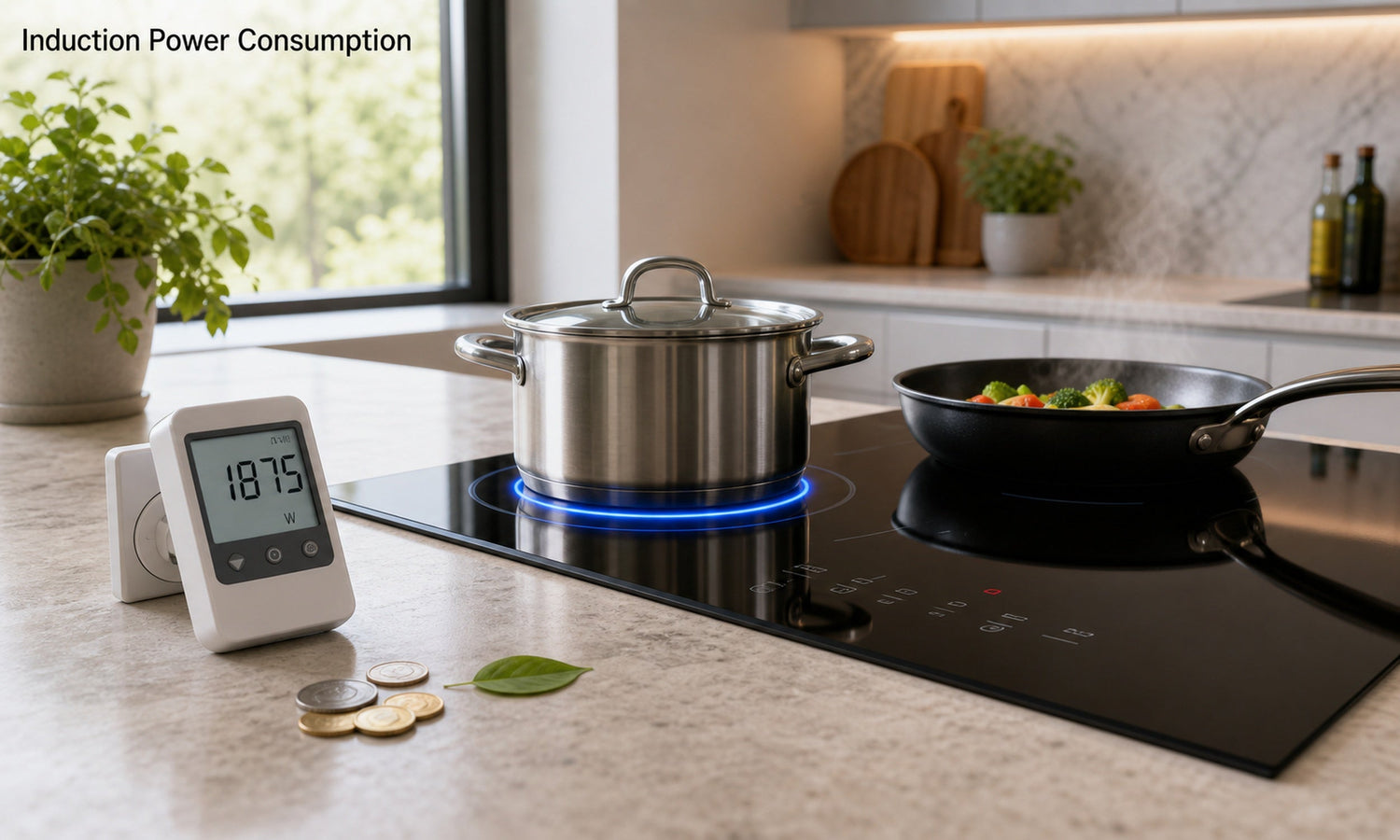
Choosing an induction cooktop is not only about cooking speed and convenience—it can also have a significant impact on how much electricity your kitchen uses. Understanding induction cooktop power consumption, wattage, energy efficiency, and running costs can help you choose the right cooktop for your cooking habits without paying for more power than you actually need.
But does a higher-wattage induction cooktop always use more electricity? How much energy does an induction stove really consume compared with gas or traditional electric cooking? And can a low-wattage model provide enough power for everyday cooking?
This guide explains how induction cooktop wattage affects electricity use and cooking costs, while also covering practical ways to improve energy efficiency.
What Determines Induction Cooktop Energy Consumption?
The electricity an induction cooktop uses depends on more than its maximum wattage. Factors such as cooking time, power setting, cookware efficiency, pan size, and the amount of food being heated all influence actual energy consumption.
A higher wattage means the cooktop can deliver more power in a shorter period, but it does not necessarily mean higher electricity costs for every meal. The amount of energy used depends on both power and cooking time.
For example, a cooktop operating at a higher power level may heat water faster and therefore finish the cooking task sooner. On the other hand, a lower-wattage cooktop may use less power at any given moment but take longer to complete the same task.
Understanding this difference between power (watts) and energy consumption (watt-hours or kilowatt-hours) is essential when evaluating the real running cost of an induction cooktop.
Understanding Watts (Power) vs. Watt-Hours (Energy Consumption)
Watts (W) — The Speed of Heating (Power)
Watts measure the rate at which an induction cooktop draws electricity at any single moment. Think of wattage as the top speed or horsepower of a car.
What it means for cooking: Higher wattage (e.g., 1,800W–3,700W on standard U.S. cooktops) means the burner can generate heat faster, boiling water or preheating a skillet almost instantly.
Why it matters: Lower power settings (like 300W or 500W) are used for gentle simmering, while higher power settings (like 1,800W on standard 120V portable units or 3,000W+ on 240V built-in cooktops) are reserved for rapid boiling or searing.
Watt-Hours (Wh) & Kilowatt-Hours (kWh) — The Total Electricity Used (Energy)
Watt-hours (and kilowatt-hours, where 1 kWh = 1,000 Wh) measure the total amount of electricity consumed over time. This is the exact metric your utility company uses to calculate your electric bill.
The Formula: Energy (Watt-Hours) = Power (Watts) ×Time (Hours)
How it works in practice:
Running an induction element at 1,800 Watts for 10 minutes (1/6 of an hour) uses 300 Wh (0.3 kWh).
Running an element at a low simmer of 600 Watts for 30 minutes (1/2 hour) uses 300 Wh (0.3 kWh).
Does an Induction Stove Use a Lot of Electricity?
Induction cooking uses electricity, but electricity consumption depends heavily on how and how long the cooktop is used. Induction technology transfers energy directly into compatible cookware, which can reduce wasted heat compared with conventional cooking methods.
If you're wondering whether an induction stove uses a lot of electricity, the better question is how many kWh it uses for your typical cooking routine. Your cooking frequency, selected power level, cookware, and cooking time all matter.
For a deeper explanation of actual electricity use, see Does an Induction Stove Use a Lot of Electricity?
How Much Electricity Does an Induction Cooktop Use in Everyday Cooking?
An induction cooktop typically uses between 0.25 kWh and 0.75 kWh per meal, which translates to about 0.5 kWh to 1.5 kWh per day for an average family. In terms of cost in the U.S. (at an average electricity rate of ~$0.16 per kWh), running an induction cooktop costs about $0.08 to $0.24 per day, or roughly $2.50 to $7.50 per month.
Here is a breakdown of electricity consumption by common everyday cooking tasks:
| Cooking Task | Power Setting | Duration | Energy Used (kWh) | Estimated Cost (U.S.) |
| Boiling 1 Quart of Water | High Power / Boost (~1,800W–3,000W) | ~2–3 min | 0.06 – 0.10 kWh | ~$0.01 – $0.02 |
| Searing Meat / Stir-Frying | Medium-High (~1,500W–1,800W) | 10 min | 0.25 – 0.30 kWh | ~$0.04 – $0.05 |
| Simmering Rice, Soup, or Sauce | Low Power (~300W–600W) | 30 min | 0.15 – 0.30 kWh | ~$0.02 – $0.05 |
| Full Dinner | 2–3 Active Burners | 30–40 min | 0.50 – 0.80 kWh | ~$0.08 – $0.13 |
Why Induction Cooking Can Be Energy Efficient
Induction cooktops work differently from conventional electric heating elements. Instead of primarily heating a burner and then transferring heat to a pan, induction technology uses an electromagnetic field to generate heat directly in compatible cookware.
This direct heating process can reduce heat losses and transfer energy efficiently to the pan. It also allows the cooking surface to respond quickly when you increase or decrease the power level.
However, energy efficiency should not be confused with low wattage. While a lower-wattage cooktop can save energy in specific scenarios—such as long, low-temperature cooking tasks like slow simmering, holding soups warm, or melting chocolate where high heat is never required—it is not always the most efficient choice.
For low-heat tasks, lower wattage avoids unnecessary power spikes and thermal loss.However, selecting the right wattage for your specific cooking needs delivers far greater overall energy savings.
During that extended heating time, heat continuously escapes into the surrounding kitchen air, resulting in greater total energy loss over time. A cooktop with a higher, properly matched power rating reaches target temperatures rapidly, locking in heat and shutting off much sooner—ultimately using fewer total kilowatt-hours kWh to complete the meal.
You might be interested in:
- Low Wattage Induction Cooktops: A Smart Choice for Energy-Saving Kitchens
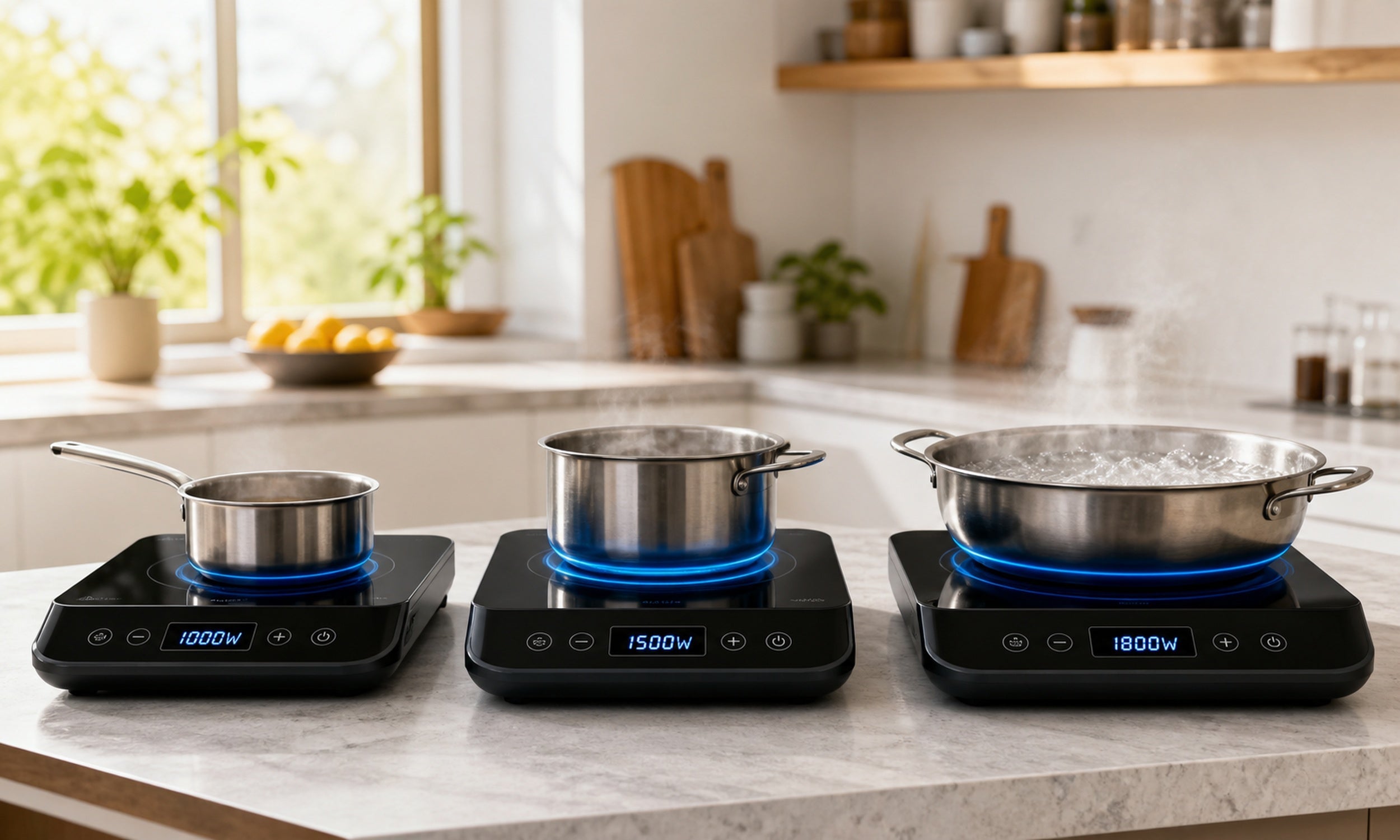
- Induction Cooktop Wattage Guide: 1000W vs 1500W vs 1800W
How to Choose the Right Power Level for Your Needs
Selecting the right induction power level requires matching the heat output to your specific cooking task for optimal performance and energy efficiency.
| Power Range (Wattage / Levels) | Ideal Cooking Tasks | Operational Tip |
|
High / Boost (1,800W–3,700W / Levels 9–P) |
Rapid boiling, searing meats, preheating large pots | Use briefly to reach temperature, then drop down immediately to save energy. |
|
Medium-High (1,200W–1,500W / Levels 7–8) |
Stir-frying, pan frying, reducing sauces | Best for active cooking that requires rapid moisture evaporation and high pan heat. |
|
Medium (800W–1,000W / Levels 5–6) |
Sautéing vegetables, cooking eggs, shallow frying | The standard baseline setting for general stovetop cooking after preheating. |
|
Low (300W–600W / Levels 2–4) |
Simmering rice, stewing, cooking delicate fish | Minimizes electricity draw during longer cooking sessions while maintaining heat. |
|
Keep Warm / Melt (100W–200W / Level 1–Warm) |
Melting chocolate/butter, holding food warm |
Consumes minimal power and prevents burning without needing a double boiler. |
What Actually Determines Your Induction Cooking Energy Use?
Your actual induction cooking energy consumption (measured in kilowatt-hours, or kWh is determined by five primary factors:
Cooking Time & Power Settings: Total energy equals power multiplied by time (kWh = kW × time -hours). Running a 1,800W burner at full power for 10 minutes uses far more energy than simmering at 400W for the same duration.
Cookware Efficiency & Material: Induction relies on magnetic friction. Magnetic stainless steel and cast iron pans with thick, flat bases absorb up to 90% of the electromagnetic energy, whereas warped, light, or poorly magnetic pans waste energy through inefficient heat transfer.
Pan Size Matching: If a small pan is placed on a large induction ring, the outer coils deactivate or waste magnetic flux, reducing efficiency. Matching pan diameter to the burner zone maximizes energy delivery.
Food Volume & Initial Temperature: Heating 2 quarts of cold water from the tap requires twice as much energy as heating 1 quart. Dense or frozen foods demand significantly more kWh to reach cooking temperatures.
Cooking Method & Lids: Leaving a lid off allows heat to escape rapidly into the kitchen air, forcing the cooktop to stay on longer and consume up to 20–30% more electricity to maintain temperature.
- Practical Ways to Reduce Electricity Usage with Induction Cooking
- Best Cookware for Induction Cooktops: Choose the Right Pan for Better Energy Efficiency
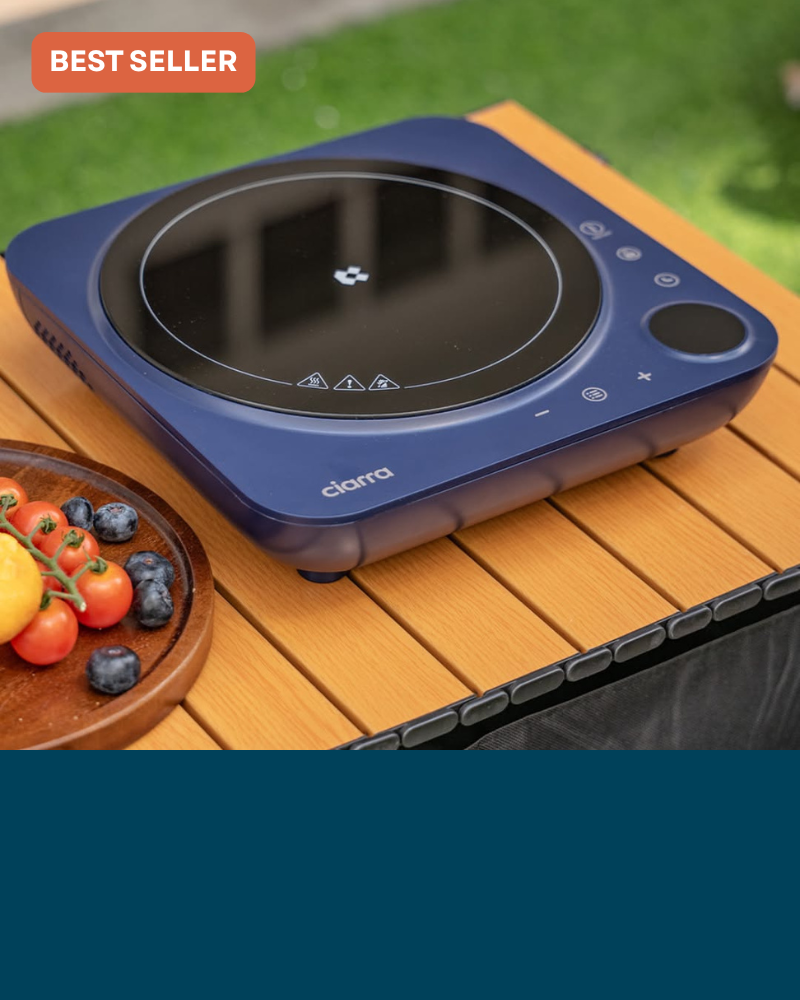
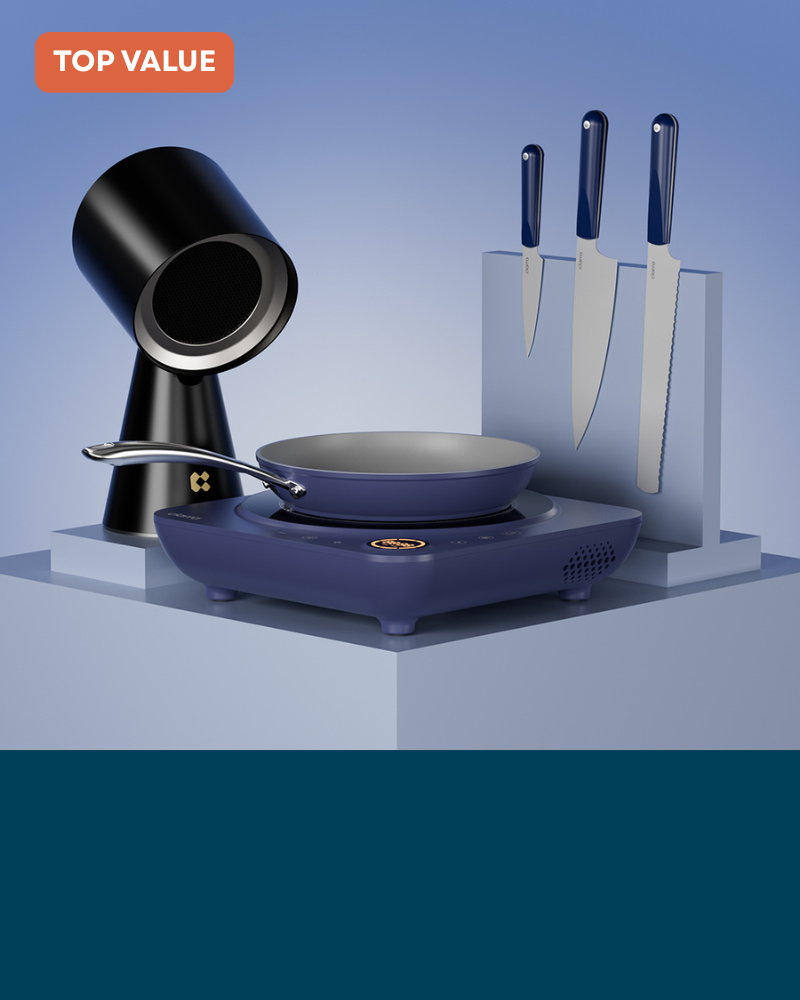
Shop Gadgets Donut Portable Induction Cooktop
Looking for an energy-efficient, versatile cooktop that fits any kitchen layout or lifestyle? The Gadgets Donut Portable Single Induction Burner combines sleek aesthetics with high-performance induction technology.
Designed for plug-and-play convenience, it offers precise temperature control and maximum energy efficiency whether you are cooking in a compact apartment, outdoor patio, RV, or looking for an extra burner at home.

| Feature | Specification Details |
| Power Output | 1,500W (USA - 120V / 60Hz) | 2,000W (EU/UK - 220–240V / 50Hz) |
| Control & Settings | 8 Power Levels | Temperature range: 140°F to 460°F |
| Timer & Safety | 4-Hour Timer (1-min increments), Child Safety Lock, Auto Pan-Detection, Residual Heat Indicator |
| Energy Efficiency | Cooks 50% faster than gas/electric; heats strictly within the pan diameter to eliminate energy waste |
| Dimensions & Weight | 11.8" x 11.8" x 3.0" (300 x 300 x 76 mm) | 4.63 lbs (2.1 kg) |
| Cookware Compatibility | Fits magnetic cookware (cast iron, stainless steel, enameled iron) 4 to 10 inches in diameter |
| Safety Certifications | ETL & FCC Certified |
Why Choose the Gadgets Donut Induction Cooktop?
Cook up to 50% faster with direct electromagnetic heating. Designed for sleek portability, precise temp control (140°F–460°F), and zero wasted energy.
- Smart Power: 8 Levels (Up to 1,500W US / 2,000W EU/UK)
- Built-in Safety: 4-Hour Timer, Child Lock & Auto Pan-Detection
- Compact & Durable: Bump-proof rounded edges & quiet fan cooling
Quick Specs
| Power | 1500W (120V) |
| Temp Range | 140°F – 460°F |
| Pan Size | 4" – 10" Base |
| Weight | 4.63 lbs (2.1kg) |
FAQs
Is a Higher-wattage Induction Cooktop Less Energy Efficient?
Not necessarily. Higher wattage means greater potential power output, but overall energy consumption also depends on cooking time and power settings.
Does a 1000W Induction Cooktop Use Less Electricity than an 1800W Model?
It uses less power when both operate continuously at their rated maximum, but it may take longer to complete the same cooking task. Total energy consumption therefore depends on both wattage and cooking time.
Can Cookware Affect Induction Electricity Consumption?
Yes. Properly sized, flat-bottomed, induction-compatible cookware can improve heat transfer and help avoid unnecessarily long cooking times.
What is the Easiest Way to Reduce Induction Cooking Electricity Use?
Avoid unnecessary high-power cooking, match cookware to the cooking zone, reduce cooking time where possible, and turn the cooktop off promptly when cooking is finished.
Does an Induction Cooktop Require Special Wiring?
It depends on the model and its electrical specifications. Higher-powered or built-in induction cooktops may have specific voltage, amperage, or circuit requirements, so always check the manufacturer's installation instructions.

Leave a comment
All comments are moderated before being published.
Este site está protegido pela Política de privacidade da hCaptcha e da hCaptcha e aplicam-se os Termos de serviço das mesmas.