


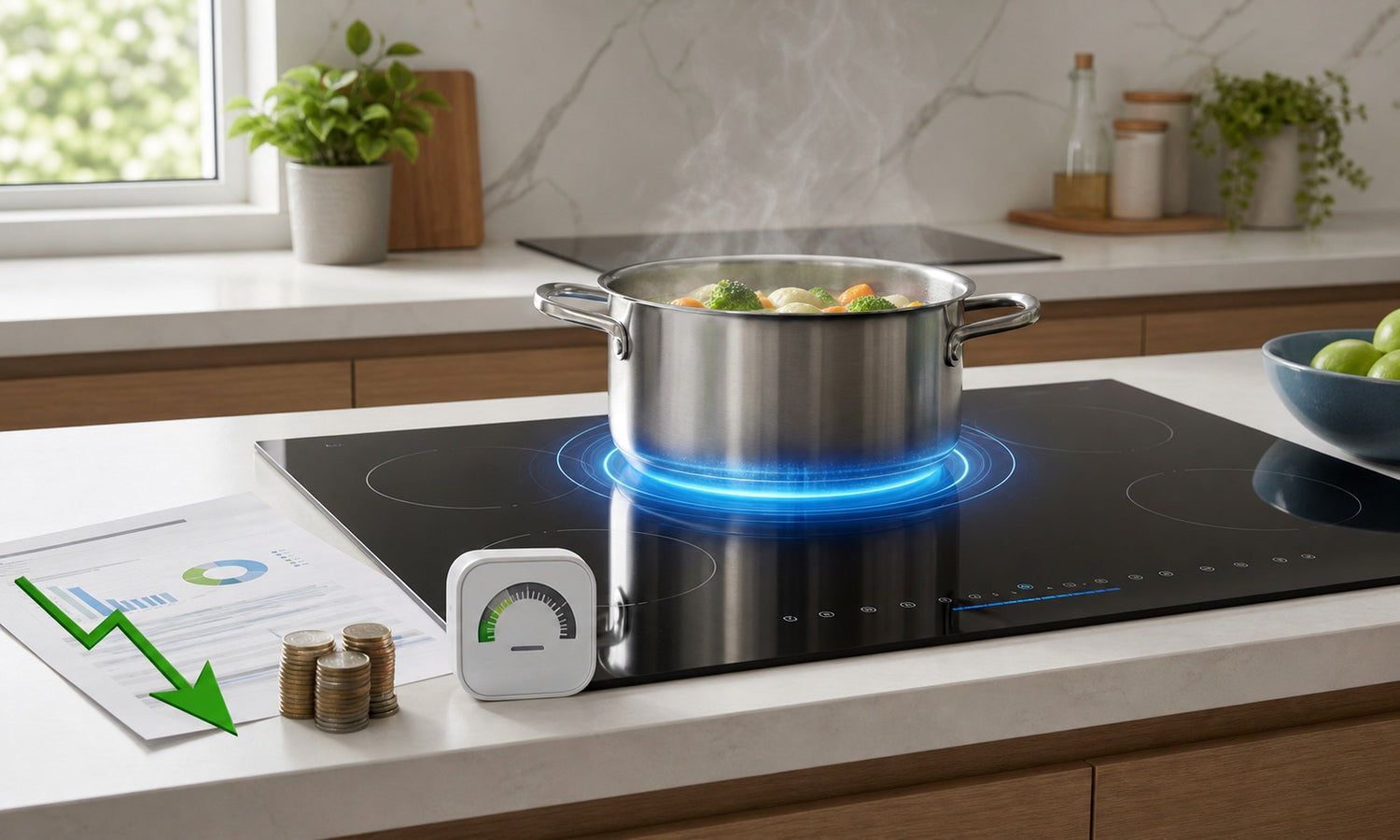
When upgrading to an induction cooktop, it’s easy to get sticker shock from the technical specifications. Seeing a "3000-watt" or "3700-watt" power rating on a spec sheet immediately triggers energy anxiety. Will switching to induction cause your monthly electricity bill to skyrocket?
The short answer is no. Looking only at the maximum wattage ignores the most crucial factor: time. Because induction heats the cookware directly via magnetic fields, it works incredibly fast, meaning high wattage is only drawn for brief periods.
Real-World Cooking Scenarios vs. Energy Anxiety
The 2-Minute Boil: How Much Electricity to Boil Water on Induction?
Boiling water is the ultimate litmus test for kitchen appliances. On a traditional gas or radiant electric stove, boiling a large pot of water for pasta can feel like an eternity because up to 50% of the energy escapes into the surrounding air.
On a high-efficiency induction cooktop, boiling 4 cups (about 1 liter) of water typically takes under 2 to 3 minutes using the "Power Boost" setting (around 3,000W).

The Math: Running a 3,000W element for 2.5 minutes consumes roughly 0.125 kWh of electricity.
The Cost: At the average US residential electricity rate of about 17 cents per kWh, boiling that water costs just about 2 cents.
Because it transfers 90% of its energy directly to the pan, induction delivers a rapid, energy-saving "drop-the-mic" performance compared to any other cooking method.
The Low-and-Slow Test: Does an Induction Cooktop Simmer Use Less Electricity?
A common worry is that long, slow cooking—like simmering a Sunday pasta sauce or bone broth for hours—will drain a massive amount of power.
However, induction cooktops do not run at full capacity when simmering. When you drop the setting to a low level (usually levels 1–3, or roughly 200W–500W), the cooktop modulates its power.
Maintaining a low simmer for 2 hours at an average pulse of 300W consumes only 0.6 kWh. 300 W × 2 = 0.6 KWH
That’s roughly 10 cents for a two-hour simmer.
Energy Consumption: Induction vs. Slow Cooker
If you love slow-cooked stews or pot roasts, you might wonder: Is it cheaper to use my countertop slow cooker (Crock-Pot) or my induction hob?
- Countertop Slow Cooker: A standard slow cooker draws about 150W to 250W on "Low" or "High" settings. Running it for 6 hours consumes between 0.9 kWh and 1.5 kWh.
- Induction Hob: Simmering a heavy, tightly covered Dutch oven on an induction cooktop can achieve the exact same tender results in about 2 to 3 hours because the heavy cast iron retains heat perfectly. At a low 300W setting for 2.5 hours, it consumes just 0.75 kWh.
The Verdict: Thanks to shorter cooking times and precise temperature control, simmering on an induction cooktop is often more energy-efficient than running a countertop slow cooker all day.

The Phantom Load: Induction Stove Standby Power Consumption
Because induction cooktops rely on electronic control panels and digital sensors, they do draw a tiny amount of electricity even when turned off—known as standby power or a "phantom load."
Fortunately, modern induction cooktops are strictly regulated. Average standby power consumption ranges from 1 to 2 watts. Over an entire year, a standby draw of 1.5W totals about 13 kWh, which equals roughly $2.20 per year. Leaving your cooktop plugged in will not noticeably impact your utility bill.
Part 2: Maximizing Efficiency & Avoiding Common Pitfalls
To ensure your induction cooktop runs at peak efficiency and keeps your electric bill as low as possible, pay attention to your cookware choices and operating habits.
Best Cookware for Induction Stove Energy Efficiency
Induction only works if the cookware is ferromagnetic. However, not all induction-compatible pans are created equal. The material thickness and base construction dictate how fast heat transfers.
Cast Iron & Enameled Cast Iron (e.g., Dutch Ovens): Exceptional heat retention. Once they reach the desired temperature, you can drop the induction setting significantly lower than you would with thinner pans, saving substantial electricity over long cooking sessions.
Fully Clad Stainless Steel (with a magnetic core): Offers the fastest response times and highly uniform heat distribution, minimizing the time the element needs to draw maximum power.
Efficiency Tip: Avoid pans with warped, uneven bottoms. A perfectly flat bottom ensures maximum magnetic contact and zero energy waste.
Does the Wrong Pan Size Waste Electricity on Induction?
On a traditional radiant electric or gas stove, using a small pan on a large burner wastes massive amounts of energy because heat escapes around the sides of the cookware.
Does the same rule apply to induction? No. One of induction's smartest features is automatic pan detection. The magnetic field is only activated where the iron structure of the pan actually touches or covers the coil underneath. If you place a 6-inch pan on an 8-inch induction zone, the cooktop will only generate a magnetic field corresponding to the 6-inch footprint of the pan. No energy is radiated out into the empty space.
Note: While it won’t waste electricity, placing a massive 11-inch pan on a tiny 5-inch zone is not recommended, as it will cause uneven heating and slower boil times. Try to match the pan size to the element for the best cooking performance.

How to Optimize Induction Hob Power Settings
To get the absolute most out of every watt, adjust your cooking habits with these three simple tips:
- Use "Boost" Only to Initiate: Use the maximum power or "Boost" setting strictly to bring water to a boil or preheat a heavy pan for a few seconds, then immediately drop down to a medium-high setting to maintain the cook.
- Match the Lid to the Pot: Cooking with a lid traps steam and heat, allowing you to drop your power setting by 2 to 3 levels while maintaining the exact same boil or simmer.
- Leverage Residual Heat: While induction doesn't heat up the glass cooktop directly, the glass does get hot from the reflected heat of the pan. You can turn off the element 1–2 minutes before your food is completely done; the residual heat stored in heavy-bottomed cookware will finish the job for free.
Related: Do Induction Cooktops Use a Lot of Electricity
Energy-Saving & Cost-Efficient Highlights of the Gadgets Donut Pink Portable Induction Cooktop
The Gadgets Donut Pink Portable Induction Cooktop is engineered to optimize energy usage, cut down cook times, and keep your utility bills low:

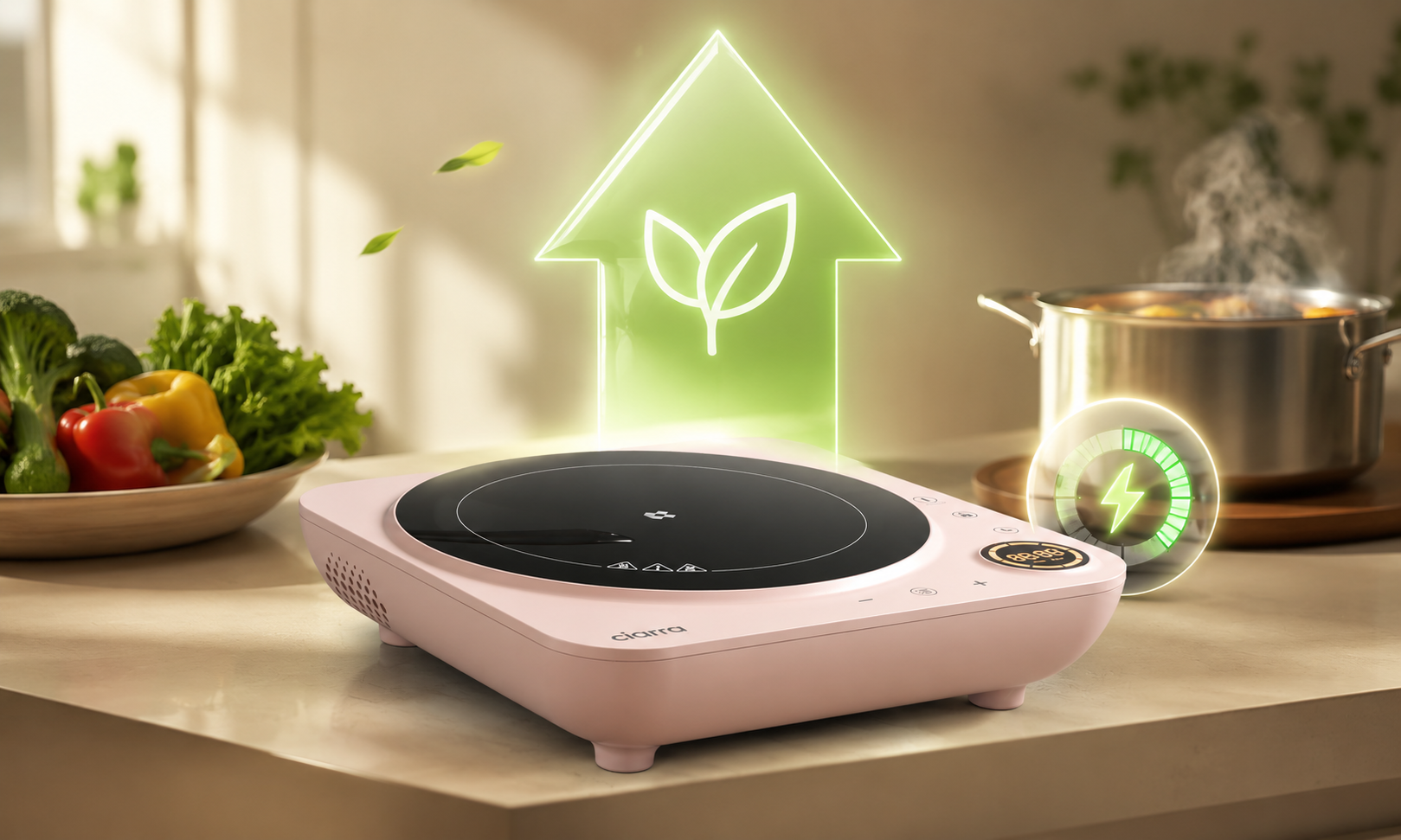
50% Faster Cooking Speed: By utilizing electromagnetic induction and a 3D dimensional panel that ensures uniform heat transfer, this cooktop heats up to 50% faster than traditional gas or radiant electric stoves. Less cooking time directly translates to lower electricity consumption.
Zero Wasted Thermal Energy: Unlike gas stoves—where up to 50% of the heat escapes into the surrounding air—this unit heats strictly within the diameter of your magnetic cookware (from 4 to 10 inches). Energy is transferred directly into the pan, eliminating heat dissipation and energy waste.
Automatic Pan Detection: Integrated smart sensors detect when no pan is present or when incorrect cookware is placed on the surface. The burner automatically shuts off after 60 seconds, preventing phantom energy draw and accidental power waste.
8 Precision Power Levels & Temperature Control: Ranging from a gentle 200W (140°F) for simmering to a powerful 1500W / 2000W (460°F) for high-heat searing, the system allows you to draw only the exact wattage required for your meal rather than running at maximum output unnecessarily.
Programmable 4-Hour Precision Timer: Avoid overcooking or leaving the appliance running unattended. Set your cooking time down to the minute (up to 240 minutes) so the cooktop automatically turns off the moment your meal is ready, preventing excess energy usage.

Laat een reactie achter
Alle reacties worden gemodereerd voordat ze worden gepubliceerd.
Deze site wordt beschermd door hCaptcha en het privacybeleid en de servicevoorwaarden van hCaptcha zijn van toepassing.