


If you have ever wondered what broiling in the oven cooking is or struggled with a tough, chewy steak, you are not alone. Broiling is one of the most underutilized features in the American kitchen, yet it is the single best technique for getting a steakhouse-quality sear right at home.
So, What is Broiling in the Oven?
Simply put, broiling is like an inverted outdoor grill. While baking cooks food slowly using ambient hot air circulating throughout the cavity, broiling applies intense, direct, radiant heat directly from above. By definition, broiling is a method of cooking that directly exposes your food to super high heat but typically only from the top rather than the bottom. This makes it perfect for browning, charring, or quick-cooking foods like salmon.
Understanding the difference between broiling and other oven cooking methods can also help you choose the right setting. For example, when comparing a Convection Oven vs Conventional Oven, convection cooking uses a fan to circulate hot air around the food, while conventional cooking relies primarily on naturally circulating heat. Neither method is quite the same as broiling, which uses concentrated radiant heat from above to quickly brown and sear the surface.
What Temperature is Broil?
Standard oven broilers operate at high heat—typically between 400°F and 550°F. If your appliance features settings for "High" and "Low," High broil runs around 550°F (ideal for searing steaks), while Low operates near 400°F to 450°F.
Where is the Broiler in Oven Units?
In most modern electric and gas ranges, the broiler heating element or burner is located at the top of the main oven cavity. In older gas models, where is the broiler in oven setups? It is often located in a pull-out drawer directly beneath the main oven compartment.
What Setting on the Oven Do You Broil?
Adjust your top oven rack so the surface of the food rests about 3 to 4 inches below the heating element. Turn on the "Broil" setting, let it preheat for 5 minutes, and always monitor your food closely to prevent burning.
What Is A Broiler Pan?
Some ovens may come with a metal broiling pan (oven rack), consisting of a rack on top and a drip pan underneath ( Baking pan). The slits in the top part of the pan allow air to circulate around food while keeping it out of its own juices to help with crisping.

How to Broil in an Oven – the Basics
Broiling in an oven is essentially indoor grilling, using intense, direct heat from above to cook flat cuts of uniform thickness quickly.
1. To master the basics, preheat your oven’s broiler and place seasoned meat on a slotted broiler pan about 2 to 4 inches from the heating element.
2. Slide the pan under the heat, set a timer, and flip the meat halfway through its cooking time, checking for doneness a couple of minutes early using an instant-read thermometer.
3. Once the target temperature is reached, remove the meat and let it rest loosely tented in aluminum foil for at least five minutes so the juices can redistribute.
4. Finally, slice across the grain to ensure maximum tenderness before serving.
What Foods Are Best To Cook Under The Broiler?
The broiler excels at quickly browning finished dishes, searing thin meats and fish, crisping vegetables, and toasting breads without overcooking the interior.
| Food Category | Specific Items | Rack Position | Cook Time | Target Internal Temp / Finish |
| Beef |
Steak (1" thick) Hamburger patty (¾" thick) |
4" from broiler 3" from broiler |
8–12 mins 6–8 mins |
130°F–145°F (Med-Rare to Med) 160°F (Well) |
| Chicken |
Cutlet or breast Thigh, drumstick, or wing |
3" from broiler 6" from broiler |
10–12 mins 15–20 mins |
165°F 165°F |
| Fish | Filets (½" thick) | 3–4" from broiler | 5–6 mins | 145°F (130°F for tuna/swordfish) |
| Pork |
Chop (½" thick) Chop (1" thick) |
3" from broiler 6" from broiler |
10–15 mins 19–21 mins |
145°F 145°F |
| Vegetables | Zucchini, peppers, onions, tomatoes | 3" from broiler | 10–20 mins | Charred to preference |
| Breads | Garlic bread (1" thick) | 3" from broiler | 1–2 mins | Golden brown |
| Cheesy Dishes | Macaroni & cheese, lasagna, casseroles, quiche | 3" from broiler | 1–2 mins | Melted & browned (165°F internal) |

How to Cook London Broil in Oven
A "London Broil" is technically a cooking method rather than a specific cut of beef. American butchers usually sell lean, thick cuts like top round, flank, or shoulder steak under this name. Because this meat is lean, knowing how to make london broil in the oven properly is critical to keep it tender and juicy.
To achieve maximum tenderness, marinate your steak in an acidic base (like soy sauce, Worcestershire, lemon juice, or balsamic vinegar) for at least 2 to 8 hours before cooking.

The Best Way to Cook London Broil in Oven
Step-by-step guide on how to broil in the oven:
1. Prep the Meat: Pull the marinated steak out 30 minutes prior to cooking so it approaches room temperature. Pat it thoroughly dry with paper towels (moisture prevents a good sear) and season with salt and black pepper.
2. Set Up the Broiler: Set your oven to Broil (High). Position the top oven rack 4 inches from the top burner. Place the steak on a raised wire rack inside a baking sheet or a dedicated broiler pan to catch drippings.
3. Broil Steak in Oven: Slide the pan directly beneath the top element.
4. Flip Halfway: Broil the first side, then flip the steak using tongs to sear the second side evenly.
5. Rest & Slice: Remove the steak and tent it loosely with aluminum foil for 10 minutes.
Slicing thin against the grain is the non-negotiable secret to making a budget london broil in oven taste as tender as an expensive filet mignon.
How Long to Cook London Broil in Oven?
Cook time depends on the thickness of the meat (typically 1.25 to 1.5 inches). Rely on an instant-read meat thermometer rather than the clock for precision:
| Desired Doneness | Pull Temperature | Final Temp (After Rest) | Estimated Broil Time (1.5" Thick) |
| Rare | 115°F – 120°F | 120°F – 125°F | 5–6 mins per side |
| Medium-Rare (Recommended) | 125°F – 130°F | 130°F – 135°F | 6–7 mins per side |
| Medium | 135°F – 140°F | 140°F – 145°F | 7–8 mins per side |
| Well-Done | 150°F+ | 155°F+ | Not recommended (causes toughness) |
Mastering Broiling: Tips & Tricks
Mastering the broiler comes down to treating it like an upside-down indoor grill. Direct radiant heat allows you to quickly cook thin proteins, char vegetables, and add a crispy crust to slow-cooked dishes.
Essential Tips & Tricks for Broiling
1. Preheat for Maximum Heat: Always preheat your broiler to ensure high, uniform direct heat. If you are using the broiler to finish a dish that was already baking, the oven will already be warm and ready.
2. Choose the Right Cookware: Use a broiler pan, a metal baking sheet, or a stainless steel wire rack over a pan. Never use glass or Pyrex cookware, as the intense direct heat can cause it to shatter.
3. Foil for Easy Cleanup: Line your metal baking sheet with aluminum foil under your wire rack before cooking to catch drippings and simplify cleanup.
4. Adjust Rack Distance: Keep a 3- to 5-inch gap between the broiler and the top of your food for most dishes.
5. Thinner cuts & quick browning: Move closer to the heating element.
6. Thicker cuts: Move farther down so the interior cooks without burning the outside.
7. Select the Right Foods: Choose thin cuts of protein like chicken cutlets, shrimp, fish fillets, pork chops, and thin steaks so they cook through without scorching. You can also broil vegetables, toast garlic bread, melt cheese, or char fruits like pineapple.
8. Monitor Constantly: High heat cooks food extremely fast. Watch your oven continuously, and keep in mind that some oven models recommend keeping the door slightly ajar while broiling.
9. Mind Marinades & Oils: Excessively wet or oily surfaces can cause smoke or flare-ups if placed too close to the heating element. Pat foods semi-dry or lightly oil them.
10. Rest Your Proteins: Pull meats out when they are a few degrees below your target internal temperature; carryover cooking will finish the job while keeping the meat juicy.
What Are the Benefits of Broiling?
Broiling is a fast, high-heat cooking method that uses direct heat from above. Its main benefits include:
-
Fast cooking: High direct heat can cook and brown food quickly.
-
Crispy, browned surfaces: Broiling creates a golden, caramelized, or slightly charred exterior.
-
Great for melting and browning: It is ideal for melting cheese, browning casseroles, and finishing dishes.
-
Less added fat: You can achieve a crispy exterior without using much oil.
-
Good for finishing foods: Broiling works especially well as the final step for steaks, chicken, fish, vegetables, and baked dishes.
- Enhanced flavor: High heat promotes browning and caramelization, which can add deeper, more complex flavors.
Do All Ovens Have a Broiler?
No, not all ovens have a dedicated broiler function. Many conventional ovens include a broil setting that uses intense, direct heat from the upper heating element, but some compact ovens, countertop ovens, and multifunction ovens may not offer a specific “Broil” mode.
However, an oven without a Broil setting may still be able to produce broil-like results. Check whether it has:
An upper heating element that can provide direct heat from above.
A Grill or Top Heat function, which may work similarly to broiling.
A high-temperature setting, typically around 400–500°F or higher.
Air Fry or convection functions, which can help brown and crisp the surface of food, although they do not technically replace a broiler, can achieve broil-like results.
How to Broil in an Oven Without a Broiler?
If your oven does not have a dedicated Broil setting, you can sometimes achieve a similar browning or crisping effect by using its highest temperature setting and an appropriate top-heating or convection function.
Try these steps:
Preheat the oven to its highest temperature, preferably around 400–500°F if the oven allows it.
Place the food near the top of the oven, while maintaining a safe distance from the heating element.
Use Top Heat, Grill, Air Fry, or convection mode if available.
Use a suitable baking or roasting tray and monitor the food closely as it browns.
Turn the food when necessary to achieve more even browning.
Keep in mind that this is not the same as true broiling. A traditional broiler uses concentrated, direct heat from above and generally produces faster and more intense browning.
Bake vs. Airfryer vs. Broil
Bake Mode: Uses gentle, multi-directional heat from the top and bottom heating elements at moderate temperatures (200°F–375°F). Ambient, still air surrounds the food, making it ideal for delicate items, batter, and doughs that need to cook evenly without drying out.
Air Fry Mode: Uses top/bottom heating elements combined with a powerful, high-speed convection fan to rapidly circulate concentrated hot air around the food (300°F–400°F). This intense airflow quickly evaporates surface moisture, achieving a deep-fried, extra-crispy texture with little to no oil.
Broil Mode: Bypasses air circulation entirely and relies solely on intense, direct radiant heat from the top element at high temperatures (450°F–550°F). Acting like an upside-down grill, it quickly sears thin meats, chars vegetables, or melts cheese on top of finished dishes
| Feature / Method | Baking | Broiling | Air Fryer |
| Heat Direction | All-around (Top & Bottom elements) | Top-down only (Direct radiant heat) | Rapid 360° dynamic air circulation |
| Temperature Range | Moderate: 200°F – 375°F | High: 500°F – 550°F (or High/Low) | High Convection: 300°F – 400°F |
| Primary Goal | Cook evenly while retaining internal moisture | Rapid browning, searing, & crisping tops | Rapid crisping to mimic deep-frying |
| Best Used For | Batter, doughs, casseroles, delicate meats | Thin steaks, fish, garlic bread, melting cheese | Frozen foods, wings, fries, quick veggies |
| Cookware Needed | Pans, glass dishes, baking sheets | Metal broiler pan / rimmed sheet (No Glass) | Perforated basket or air-fryer tray |
Now that you know the difference between baking, air frying, and broiling, you can tackle a wide variety of recipes. This makes having a multi-functional oven an invaluable asset in any modern kitchen. Instead of cluttering your countertop with single-use appliances, a multi-mode oven seamlessly combines gentle baking, high-speed air frying, and intense broiling into one powerful unit. With a single versatile appliance, you can easily switch between baking delicate pastries, crisping up quick weeknight meals, and searing steakhouse-quality meats to perfection.
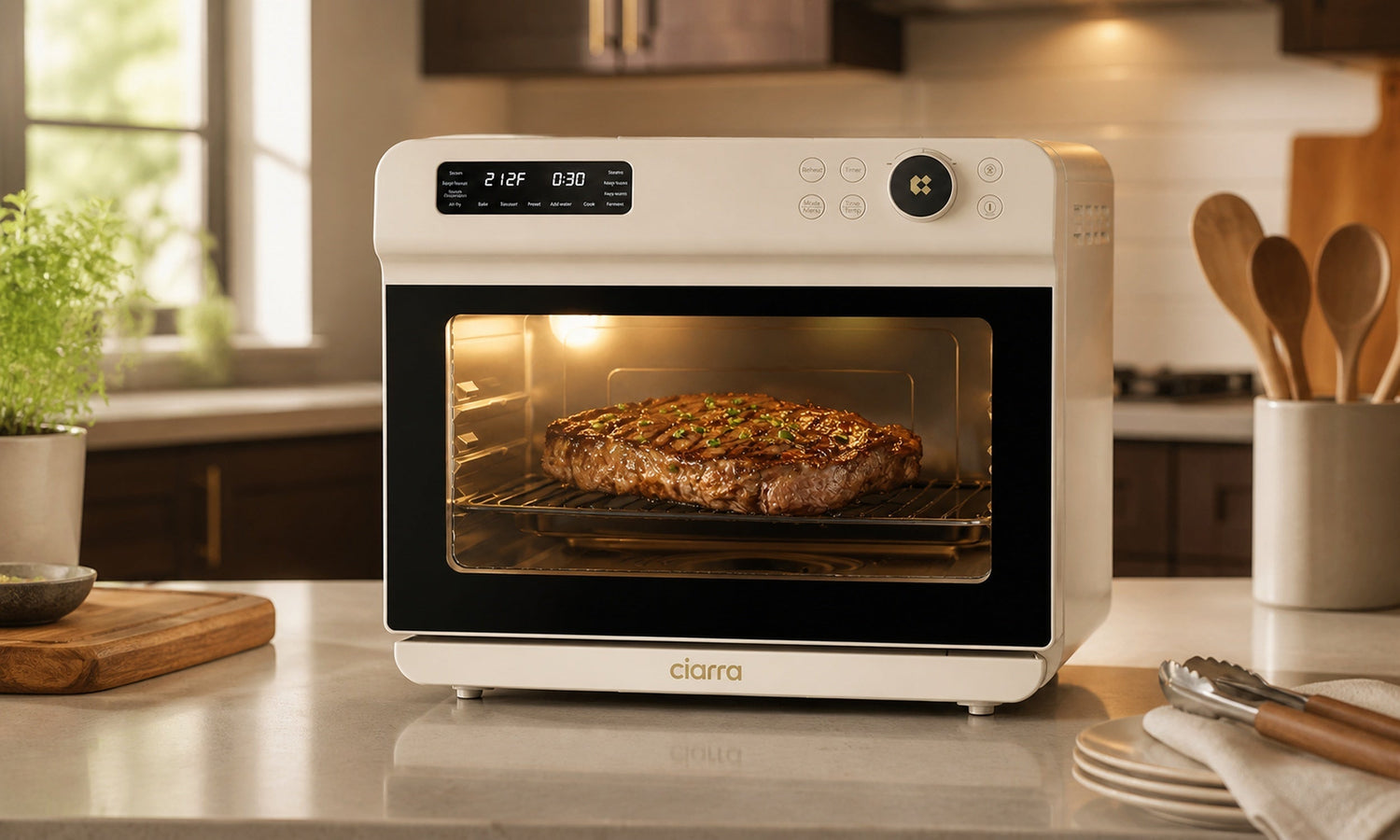
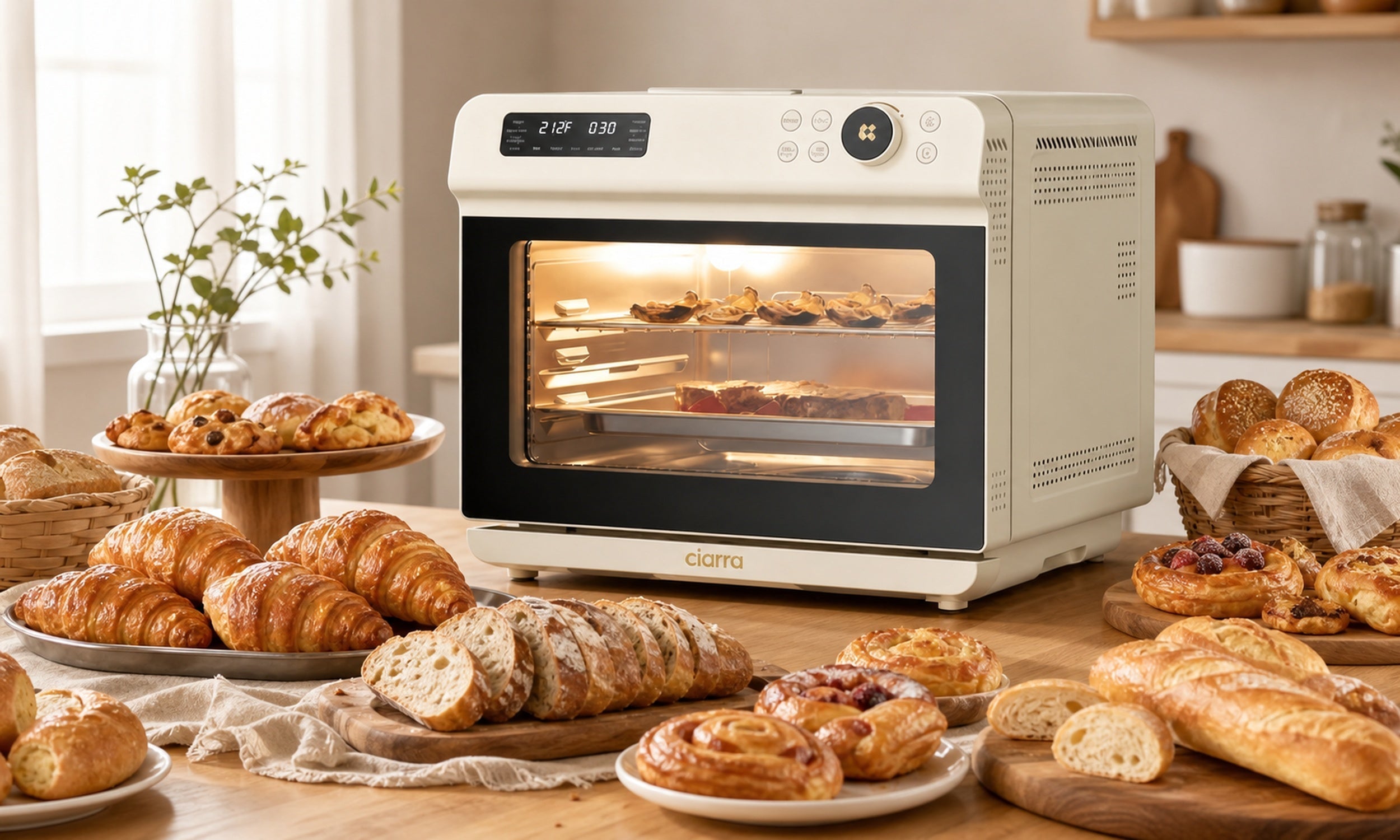
Shop The Ciarra Gadget Nosh Oven Pro

CIARRA Nosh Oven Pro (CASO24-W)
A 25.4 QT (24L) capacity countertop powerstation packing 1600W of precision performance to replace single-use clutter with a seamless 12-in-1 solution.
- 12-in-1 Versatility: Steam, Air Fry, Bake, Ferment, Dehydrate, Sterilize & more.
- Micro-Pressure Steam Tech: 0.1kPa steam in 20s locks in moisture & nutrients.
- 360° Turbo Convection: 2,800 RPM spiral fan ensures even 3D hot air crisping.
- Dual NTC Precision: Accurate real-time control from 85°F to 450°F.
- Family-Sized & Durable: 304 Stainless Steel cavity with self-cleaning features.
Here is why I love the CIARRA Nosh Oven Pro:
- All-in-One 12-in-1 Versatility: Steam, Rapid Steam, Steam Convection, Air Fry, Bake, Ferment, Dehydrate, Warm, Clean, Sterilize, Reheat, and Preset—all in one countertop unit.
- Hassle-Free Maintenance: Built-in steam cleaning and sterilization eliminate the chore of tedious manual scrubbing.
- Crispy Outside, Juicy Inside: Simply fill the 33.8 oz water tank to lock in rich moisture while achieving a perfectly golden, crispy finish.
- More Capacity, Less Time: More room than a standalone air fryer, featuring dual-level racks to cook full family meals simultaneously.
How to Achieve "Broiling" Results in the Nosh Oven Pro
While the CIARRA Nosh Oven Pro does not feature a dedicated "Broil" button, you can easily replicate intense broiling effects using its Air Fry or Steam Convection modes:
- Use the Air Fry Mode at High Temp: Set the oven to Air Fry at 400°F–450°F. The 2,800 RPM turbo fan drives concentrated, high-speed heat directly onto the surface of thin steaks, chicken cutlets, or fish, achieving a deep-sear and golden crust similar to a traditional broiler.
- Elevate Your Food: Place your food on the high rack tray closer to the top heating elements to maximize direct radiant heat exposure.
- Finish with Steam Convection: For thicker meats or cheesy casseroles, use Steam Convection at top heat to brown and crisp the exterior rapidly while preventing the interior from drying out.

Top Heat/ High-heat from the top down to create a golden, caramelized finish. Great for crisping, melting, or that final perfect touch.
You might be interested in:
You can check out the YouTuber's video below, where they tried roasting pork using the Ciarra Gadgets Nosh Oven Pro. They said that using a high-temperature zone at the end to render out the fat would make it even more delicious.

Zostaw komentarz
Wszystkie komentarze są moderowane przed opublikowaniem.
Ta strona jest chroniona przez hCaptcha i obowiązują na niej Polityka prywatności i Warunki korzystania z usługi serwisu hCaptcha.